Baltic & Regional Heritage · 2026-10-21
The Unyielding Grip: Tracing 4WD's Rallying Revolution
Four-wheel drive fundamentally reshaped rally motorsport, transforming car dynamics and driving techniques from its introduction to its current sophisticated iterations. It remains the bedrock of competitive rallying.
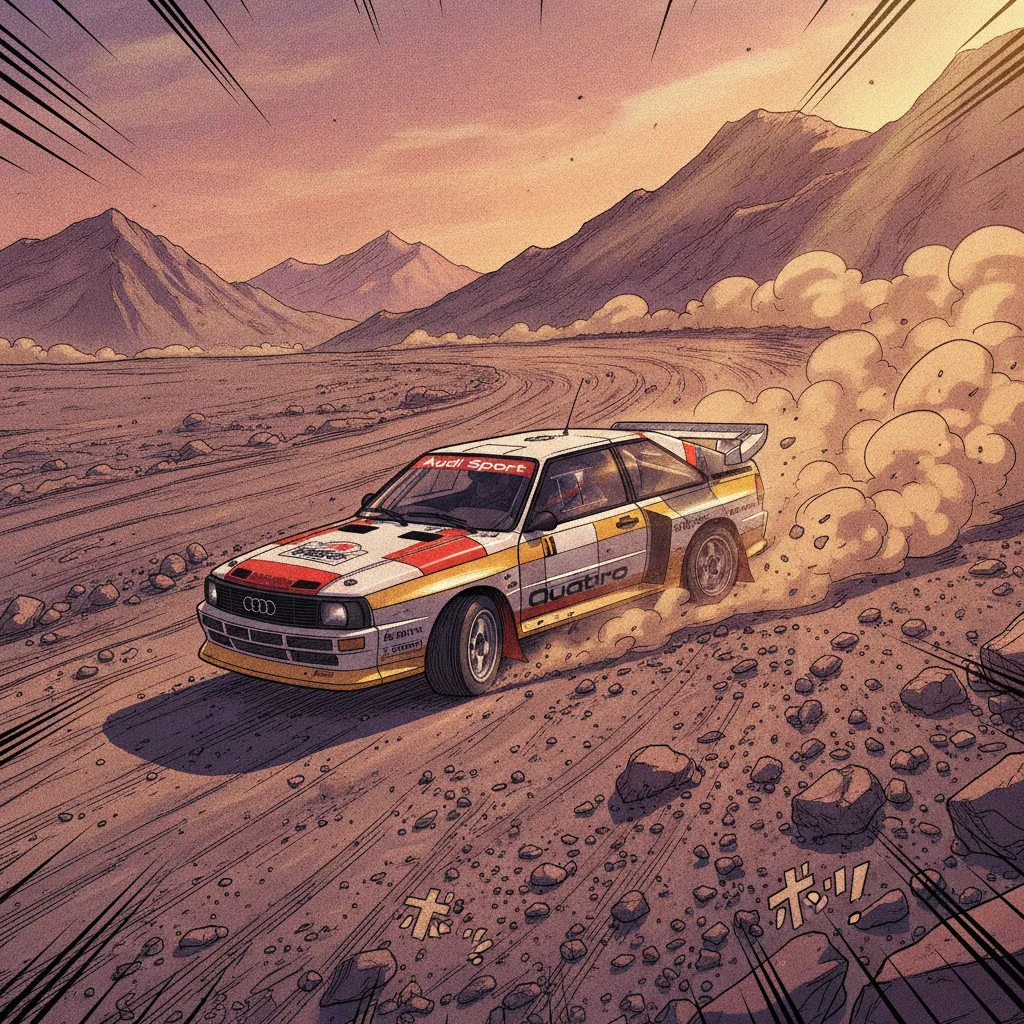
The advent of four-wheel drive (4WD) systems in rallying stands as one of the most pivotal technical innovations in motorsport history. Before its widespread adoption, rear-wheel drive (RWD) machines, powerful but often unwieldy on loose surfaces, dominated the stages. The introduction of 4WD didn't merely offer more traction; it fundamentally redefined the physics of grip, cornering, and acceleration, unleashing a new era of blistering speed and unprecedented control. This paradigm shift was so profound that it irrevocably changed the landscape of competitive rallying, demanding new driving techniques and engineering ingenuity.
Early Pioneers and Group B Domination
The catalyst for this revolution was undoubtedly the Audi Quattro. Debuting in 1980, its longitudinal five-cylinder engine feeding a permanent 4WD system, often featuring a Torsen central differential, immediately showcased a superior ability to put power down, especially on snow and gravel. The Quattro's relentless traction and stability, even with significant turbo lag, allowed drivers to carry immense speed through corners where RWD counterparts would be fighting for purchase. Its Group B iterations, like the fearsome S1 E2, pushed the envelope further, demonstrating the raw, untamed potential of sophisticated all-wheel-drive dynamics under extreme duress.
The Evolution into the WRC Era
Post-Group B, the legacy of 4WD continued to evolve through the Group A and WRC eras. Manufacturers like Subaru with their Impreza WRX STI and Mitsubishi with the Lancer Evolution refined the concept, often employing symmetrical AWD layouts and increasingly sophisticated active differentials. These systems, capable of electronically distributing torque between axles and even individual wheels, allowed for unprecedented fine-tuning of handling characteristics. Modern WRC machinery, with its multi-mode active centre differentials, hydraulic front and rear differentials, and advanced torque vectoring, represents the pinnacle of 4WD development, offering drivers surgical precision and instantaneous response to varying grip conditions across diverse rally stages.
The Enduring Impact on Rally Dynamics
The transformation wrought by 4WD is comprehensive. It elevated stage speeds dramatically, demanding quicker reflexes and an aggressive, committed driving style. Engineers constantly innovate, optimizing weight distribution, suspension kinematics, and electronic control units (ECUs) to extract every ounce of potential from these complex drivetrains. From its initial groundbreaking appearances to its current highly evolved state, 4WD remains the immutable foundation upon which championship-winning rally cars are built, a testament to its enduring superiority in the crucible of international rallying.
Ready to sell? List your rally car or parts for free.
Post an ad